Lesson 19
Time to explore 12/8 time signature.
12/8 is one of the most interesting time signatures that you will find used in pop music. So what is 12/8 time signature? With each measure consisting of twelve eighth notes, at first sight, 12/8 may look a little scary, but it doesn’t.
Time signature 12/8 contains measures that have 12 eighth-note beats.
In 12/8 each strong beat is a dotted quarter note and therefore can be divided into three eighth notes. This makes 12/8 a compound time signature. It is a Quadruple time signature because there are 4 strong beats in each measure.
As you already noticed, 4/4 time signature is the most popular time in the music. It is because its steadiness and stability. It has very balanced pulse.
The second most popular time signature is 3/4 (waltz-time) has a nice flow to it that breaks the rigidness of 4/4, replacing it with three beats in each measure, which helps make things more fluid.
So 12/8 is the combination a steady 4/4 pulse with ¾ feel. It’s 4/4 time with a 3/4 hidden inside of each beat. The incredible thing. It gives you a brilliant hybrid of the waltz quality of 3/4 and the steadiness of 4/4.
What are the difference between 12/8 and 6/8?
6/8 is also a compound meter, as it has two strong beats per measures. Each strong beat is broken down into three eighth notes, making six eighth notes per measure. This means that two measures of 6/8 with equal one measure 12/8. The difference between 12/8 and 6/8 is the same as for 4/4 and 2/4.
The link between 4/4 and 12/8
On the face of it 4/4 and 12/8 are quite different time signatures. 4/4 is a simple meter and 12/8 is compound. However, they both have four strong beats per measure. This means that if we play three notes per strong beat in 4/4 (by using a triplet), it would sound the same as a measure of 12/8. You could write 12/8 as 4/4 but you would see a lot of triplet eighth not patters.
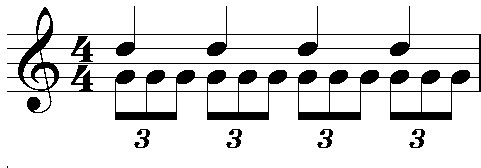
In 12/8 those are just eighth notes.

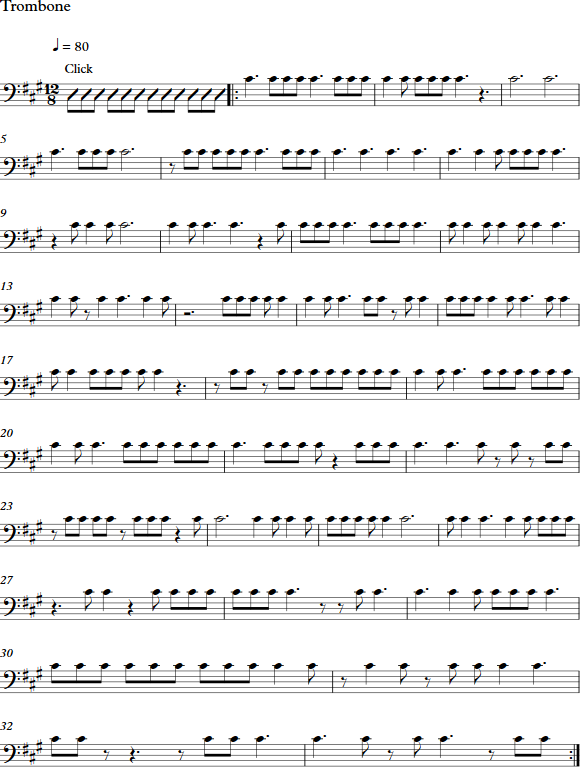
Next rhythm etude will show you notation of the 12/8 time signature