Lesson 13
Time to explore the 6/8 signature
Many of the well-known pieces of music are in 6/8 time signature. So what is 6/8, what makes it different from 3/4 time, and why does it matter?
The simple and compound meter
Simple meter
Meter is about how notes are grouped to form certain patterns. A simple meter is any meter where the “big beat” can be divided into two equal parts. So, 4/4 time consists of four quarter notes: each of those quarter notes divides into two, equal eighth notes.
Compound meter
However, a compound meter results when the “big beat” divides into three equal parts. In 6/8 time, there are two dotted quarter notes per measure, and each of those divides into three equal eighth notes.
The difference between 6/8 and 3/4 time
6/8 time has the exact same number of eighth notes as does 3/4 time. So what’s the difference between them? Here meter becomes very important as the way we group these six equal eighth notes together makes all the difference.
Take a look at one measure of 3/4 and one measure of 6/8, focusing especially on how the notes are beamed or grouped in each one.
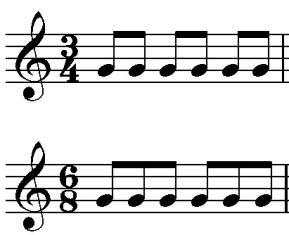
As you can see 3/4 groups the eighth notes into three equal groups of two, while 6/8 groups them into two equal groups of three. But this grouping pattern of the different meters doesn’t just affect how the notes look, it affects the way the music feels.
Tempo
An important consideration in the difference between 3/4 and 6/8 time is tempo. Too slow of a tempo for 6/8 can also affect the feel and it becomes hard to tell the difference with 3/4. So too fast of a tempo for 3/4 can often feel more like 6/8. Thus, it’s important to choose tempos that reflect the accents that make up each meter.
Accents
3/4 meter
In 3/4 we have natural accents on beats 1, 2, and 3 where 1 is strong and 2 and 3 are a bit weaker. That feel of strong-weak-weak. It is the natural feel of the waltz dance. And all waltzes are written in 3/4 time.
6/8 meter
6/8 is a compound meter. The accents fall on beats 1 and 4.